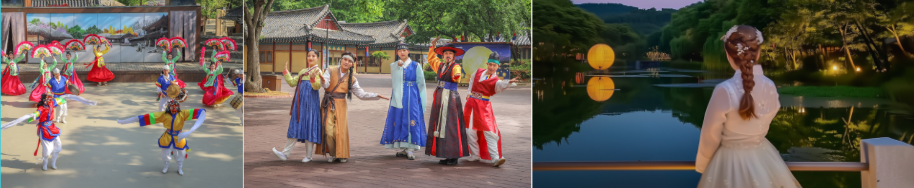
Korean Folk Village isn’t somewhere you tiptoe past glass cases in hushed silence. It’s an open-air living village where costumed artisans actually work, performers dance in the streets, and your children can try on traditional clothes, grind grain, and spin tops. Opened in 1974, the village spans over 245 acres and contains more than 260 traditional houses relocated from across Korea — authentically reconstructed to show how Koreans lived during the late Joseon era (roughly 17th–19th century).
For expat families raising children in Korea, this is genuinely one of the most powerful ways to connect the country you live in to something tangible. Everything your kids see in K-dramas, history class, or Chuseok celebrations — this is where it all comes from.

📷 Over 260 traditional Joseon-era homes spread across a vast natural landscape
The village is large — plan at least half a day, ideally a full day. Here’s what’s most memorable for families with children:
- Traditional Performances — Folk music (풍물), tightrope walking (줄타기), and farmers’ dance (농악) run on a daily schedule in the village square. Completely included in admission, and absolutely spellbinding for kids.
- Traditional Wedding Ceremony — A full Joseon-era wedding re-enactment shows children how Korean ancestors celebrated one of life’s biggest moments — gorgeous costumes included.
- Craft Street (공방거리) — Watch real artisans make straw sandals, weave fabric, fire pottery, and forge iron just as craftspeople would have 300 years ago. Many workshops invite children to try hands-on.
- Seodang (서당) — Joseon Classroom — A re-enacted traditional school lesson with a stern topknotted teacher. A fun and funny way to compare how Korean education has (and hasn’t) changed.
- Folk Games Area — Try yut-nori (윷놀이), top spinning (팽이치기), and seesaw jumping (널뛰기). These games have been played by Korean children for centuries — and they hold up surprisingly well.
Parent tip! Grab the daily performance schedule at the main gate as soon as you arrive. The tightrope walking act draws massive crowds — arrive 10 minutes early for a good view. It’s the kind of thing kids describe in detail to their friends for weeks.
One of the most beloved parts of any visit: dressing up in hanbok (한복), Korea’s traditional clothing. Rental shops just outside and inside the village entrance offer hundreds of styles for children and adults alike. Seeing your child transformed into a Joseon-era kid — silks, accessories, styled hair and all — makes for a photo you’ll be printing and framing.
“We hadn’t planned to rent hanbok, but our daughter spotted the colors from across the street and that was that. She wore it all day and cried when she had to return it. Best ₩16,000 we’ve ever spent.” — a fellow expat parent
Rental prices run approximately ₩16,000–21,000 for a full day, including accessories and basic hair styling. Shops near the entrance such as Hanbokcchon (한복촌) and Iride Hanbok are popular choices. Confirm prices on-site as they vary slightly by season.

📷 Hanbok rental turns a day trip into a full immersive experience
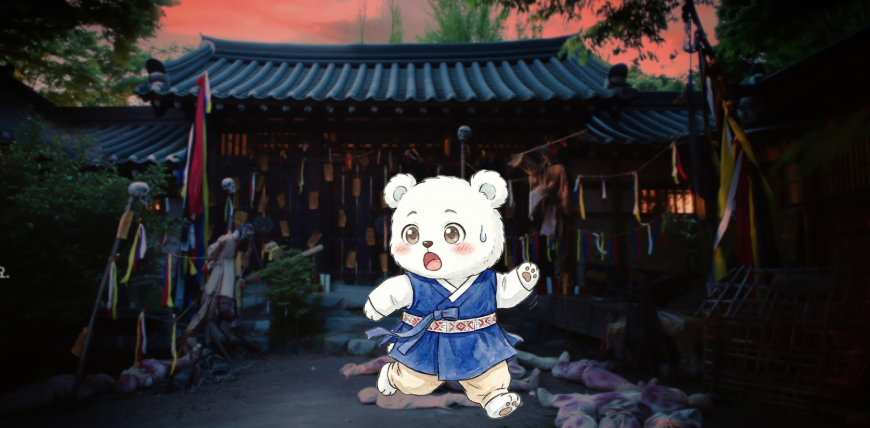
Here’s where Korean Folk Village becomes something no other cultural attraction can offer. From spring through autumn, after the last tour groups head home, the village transforms into one of Korea’s most talked-about horror experiences — drawing not from Western Halloween clichés, but from centuries-old Korean ghost mythology.
The centrepiece is the walk-through haunted attraction set inside the village’s authentic Joseon-era buildings. It draws on Korea’s ancient spirit folklore: Gwisin (귀신) are vengeful spirits in white funeral robes with long hair covering pale faces — the stuff of Korean nightmares for generations, and the inspiration behind countless K-horror films and dramas like Kingdom on Netflix.
- The Haunted Prison (귀굴 / 살귀옥) — Groups of four hold a rope and navigate pitch-black corridors inside a cursed Joseon prison, armed with only one flashlight. Wailing sounds, bell tolls, and live actors in full ghost costume. Genuinely terrifying — even for adults.
- The Haunted Den (귀신의 집) — Set inside an authentic hanok, the musty smell, creaking wooden floors, and absolute darkness build unbearable suspense before something lunges from the shadows.
- Roaming Spirits — Costumed performers wander the entire village after dark: wandering monks, pale-faced women in white, grotesque figures from Korean legend. Show fear, and they will follow you.
- Night Horror Village (Summer Special) — Typically late July to late August, a full after-dark festival adds ghost storytelling, a night market with horror-themed snacks, live performances, and even a midnight dance party with DJs. Most of this is included in the night admission.
⚠️ The walk-through haunted attraction is recommended for ages 13 and above, and is not suitable for young children, those with heart conditions, or claustrophobia. Tickets are sold separately (approx. ₩7,000–8,000) and sell out fast on weekends — book in advance via the official website or Naver.
Even families with younger children who skip the haunted house will find the village magical at night — lantern-lit, atmospheric, and unlike anything else in the Seoul area.
For expat children growing up in Korea, a visit here connects their daily life to deep cultural roots. Even for children visiting Korea briefly, the Folk Village answers questions that no classroom easily can:
- Social structure — Why did some families live in grand tiled-roof houses while others had thatched roofs? The village shows Korea’s Joseon class system (yangban nobles, commoners, servants) through architecture alone — a visual lesson that sticks.
- Daily life before electricity — How did people cook, farm, light their homes, and communicate? Every building has a living answer.
- Ghost stories as cultural history — Korean gwisin folklore reflects deep beliefs about justice, grief, and what happens when someone dies unjustly. Even the haunted experience is a form of cultural education — learning why Koreans fear what they fear.
- Language in context — Signs in Korean, hanja (Chinese characters), and English make this a natural moment to explore how Korea’s written language evolved over centuries.
Before you go: Have each child pick one thing they want to find the answer to — about food, clothing, school, or buildings. Kids who visit with a question in mind retain far more than those who just follow the crowd. After the visit, ask them to draw one thing they saw — you’ll be surprised what they noticed.
Yongin-si, Gyeonggi-do
Night opening until 22:00
(Fri–Sun, seasonal)
Child: ₩26,000
Senior / Disabled: ₩22,000
Under 36 months: FREE
~₩22,900 (adult)
~₩19,500 (child)
Getting there from Seoul: Bus 5001-1 from Gangnam Station (~50 min) or bus 4101 from Myeongdong (~45 min). A free shuttle runs from Suwon Station. Driving: paid parking is available on-site. Official website: koreanfolk.co.kr
Hours, prices, and events vary by season. Always check the official website before visiting — especially for night opening dates and haunted attraction availability. Weekend tickets (especially for the haunted experience) sell out quickly, so booking ahead is strongly recommended.
Korean Folk Village gives children something no textbook can:
the feeling of stepping into a different world, asking real questions,
and finding the answers all around them.
And if your family is brave enough to stay after dark?
You might just meet a few residents who never quite left the Joseon era. 👻