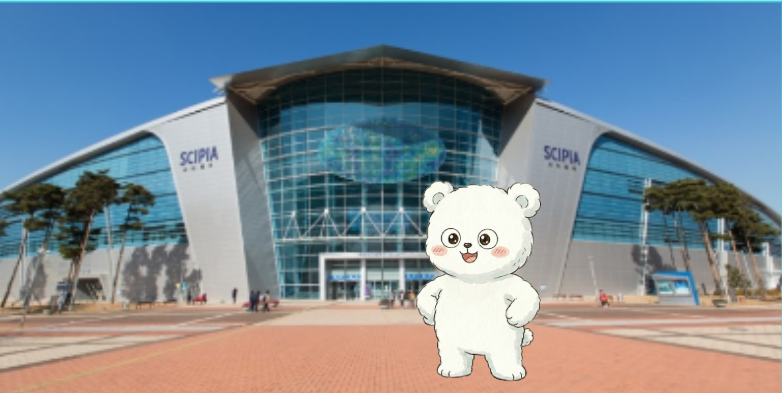
Why This Museum Belongs on Every Family’s Seoul List
“I’ve never seen my kids so completely absorbed — for five hours straight.” — A foreign parent living in Seoul
If you’re raising elementary-school-age children in Korea, or visiting Seoul with kids in tow, the Gwacheon National Science Museum is one of those rare places where parents and children both leave genuinely happy. Opened in 2008, it’s Korea’s largest national science museum, sitting right next to Seoul Grand Park in Gwacheon — an easy subway ride from central Seoul.
What makes it special for school-age kids isn’t just the scale (though it is enormous). It’s that over 50% of the exhibits are fully hands-on and interactive. Your kids won’t be reading labels — they’ll be launching rockets, touching fossils, operating robots, and crawling through insect habitats. For elementary schoolers especially, this is pure magic.
Tickets: Remarkably Affordable for a Day Out
The main museum admission is genuinely budget-friendly, especially compared to similar attractions in Seoul. Children under 7 (preschool age) get in completely free, making this ideal for families with mixed-age kids.
| Visitor Type | Main Museum | Planetarium (add-on) |
|---|---|---|
| Adults (20+) | ₩4,000 | ₩2,000 |
| Teens & Children (7–19) | ₩2,000 | ₩2,000 |
| Under 7 years old | FREE Free | FREE Free |
| Seniors (65+) | FREE Free | ₩1,000 |
| Group (20+ people) | ₩1,000 discount per adult | — |
A typical family of 2 adults + 2 elementary schoolers would spend just ₩12,000 (about $9 USD) on admission. Wednesday visitors get 50% off individual tickets — a great hack for families with flexible schedules.
Note that your ticket allows same-day re-entry, so you can pop out for lunch at a nearby restaurant and come back in.
The Space Analog experience has its own pricing: the guided tour version costs ₩2,000 per person (available from Grade 3 and up), while the full hands-on experience costs ₩10,000 per person (Grade 5 and up). These must be booked separately and are worth considering for older elementary kids who love space.
How to Reach the Museum
The museum is straightforward to reach by both subway and car. Most families living in Seoul will find the subway the easiest option — especially since parking on weekends fills up fast.
Take Seoul Subway Line 4 (Blue Line)
From central Seoul: Myeongdong → Sadang → Daegongwon. The ride from Myeongdong takes about 25 minutes. From Gangnam area, transfer at Sadang (total ~20 min).
Exit at Daegongwon Station, Exit 6
The station is named “Grand Park” in English. Use Exit 6 specifically — it faces the Science Museum directly. No long walk needed.
Walk 2–3 minutes to the entrance
Follow the signs for 과학관 (Science Museum). It’s clearly visible from the exit. The path is stroller-friendly and flat.
If you’re driving, enter 경기도 과천시 상하벌로 110 into Naver Maps or Kakao Maps. Parking costs ₩5,000 for a full day (flat rate, paid on entry — not on exit). On busy weekends, you can also park at Seoul Grand Park and walk over in about 5 minutes.
Exhibition Halls: What to Prioritize with Elementary Schoolers
The museum has six permanent exhibition halls plus several specialty areas. Here’s what tends to be the biggest hits for elementary-age kids:
Science Exploration Hall
Hands-on experiments covering physics, chemistry, and biology. Kids can experience a tornado simulator and dozens of interactive stations.
Ages 7–13Natural History Hall
Life-size dinosaur skeletons and fossils. An absolute crowd-pleaser for most elementary-age kids — budget extra time here.
All AgesAstronomical Space Hall
Space exploration exhibits, rocket models, and interactive displays about the universe. Pairs perfectly with the Planetarium next door.
Ages 8+Future Imagination SF Hall
Robots, AI, energy, and life science. The VR and AI exhibits here feel like video games — kids often spend hours without realizing it.
Ages 9+Korean Science Civilization Hall
Korea’s scientific history and inventions. More reading-heavy than other halls, but the traditional technology demonstrations are fascinating.
Ages 10+Insectarium
Live insects and interactive insect-themed exhibits. Kids who love bugs absolutely love this. Even bug-skeptics usually come around.
All AgesThere’s also a dedicated Kids’ Play Area on the first floor, designed for children ages 3–7. This requires a free advance reservation through the museum’s website — slots are limited and do fill up, especially on weekends. If you have younger siblings along, book this before your visit.
Hours, Closures & Timing Tips
| Day / Period | Hours |
|---|---|
| Tuesday – Sunday | 9:30 AM – 5:30 PM (last entry 4:30 PM) |
| Monday | CLOSED |
| Seollal (Lunar New Year’s Day) | CLOSED |
| Chuseok (Korean Thanksgiving Day) | CLOSED |
| January 1st | CLOSED |
If Monday falls on a public holiday, the museum closes the following weekday instead. Always double-check the official website before visiting on or around Korean public holidays.
Navigating the Museum as a Non-Korean Speaker
Here’s the honest reality: most exhibit labels and explanations are in Korean only, with limited English translations. This sounds like a bigger barrier than it actually is — because most exhibits are interactive and visual, meaning your kids can figure out what to do just by watching and trying.
The museum entrance, signage for navigation, and basic facility information (restrooms, exits, cafeteria) are available in English. For the content of specific exhibits, however, Korean reading ability helps. One practical approach many expat families use: let the kids explore freely and experiment, rather than focusing on the written explanations.
The museum website (sciencecenter.go.kr) has some English content, and staff at the information desk can often communicate in basic English. The Naver Maps app is recommended over Google Maps for Korean addresses — enter the Korean address for more reliable navigation.
Family Amenities: Everything You Need for a Comfortable Day
The museum is well-designed for families and was built with accessibility in mind throughout.
What’s Available
Food inside the museum is reasonably priced for a museum cafeteria. If you want more variety, the surrounding Gwacheon area has plenty of restaurants — and since your ticket allows re-entry, you can go out for lunch and return afterward.
Nearby Attractions to Make It a Full Day
The museum sits within Seoul Grand Park — a massive recreational complex that’s worth exploring before or after your museum visit.
Seoul Grand Park Zoo
One of Korea’s largest zoos, right next door. A great add-on if the kids have energy left. Separate admission required.
Seoul Land
An amusement park within Seoul Grand Park. Popular with elementary-age kids, especially those who like rides.
Outdoor Park & Gardens
The park itself has trails, botanical gardens, and wide green spaces — perfect for a post-museum walk or picnic.
MMCA Gwacheon
The National Museum of Modern and Contemporary Art is a 10-minute walk. A good addition for art-loving older kids.
Your Pre-Visit Checklist
Don’t Forget
Address: 110 Sanghabeol-ro, Gwacheon-si, Gyeonggi-do · Korean: 경기도 과천시 상하벌로 110